How Mike Smallcombe Contradicted His Own Claims About The Neverland Train Station

Oct 10, 2019
Mike Smallcombe, a committed apologist of Michael Jackson, continues to insist that the main Neverland train station was not fully constructed until the spring or summer of 1994—around eighteen months after the period in which James Safechuck says the abuse occurred. This claim is repeated in the documentary Chase the Truth, where Smallcombe appears alongside a rather questionable cast of contributors, including Matt Fiddes.
What Smallcombe fails to acknowledge is the sheer scale of Neverland. Jackson’s former ranch covered more than 2,700 acres and, by the mid‑1990s, contained at least 50 to 100 buildings, along with two trains and multiple stations. Despite this, Smallcombe fixates on the main Neverland Train Station simply because it is the one shown on screen in Dan Reed’s Leaving Neverland. He then treats that single location as the only possible setting for James’s account, which is an oversimplification at best.
Several months before Chase the Truth was released, I emailed Smallcombe to ask whether he intended to address any inconsistencies in survivors’ timelines or locations—issues that child‑molestation expert Kenneth V. Lanning has documented extensively. Despite presenting himself as a journalist, Smallcombe showed little interest in exploring these imperfections or applying the same scrutiny he demands of others.
This was my second attempt to contact him. The first email, sent on 4 May, went unanswered. The follow‑up, sent on 27 May, received the same silence.
second email:
Hello, I sent you an email on 4 May, asking why you hadn’t included important facts about inconsistencies made by genuine sex abuse survivors in any of your Neverland train station news articles, et cetera.
I don’t know why you haven’t replied; perhaps it’s because you don’t want to acknowledge that genuine survivors do mix up dates and locations, because it doesn’t suit your pro-Jackson agenda.
However, because I’m an honest and fair person, I will make you fully aware that I will be making a blog post about your Neverland train findings, and highlight why you have left out important facts.
You can give your honest reason why you haven’t included those facts, or you can just ignore me.
Either way, it’s your choice.
Mike Smallcombe’s response:
My work was to research the facts that Dan Reed, the director, failed to find and/or deliberately left out of the documentary. I’m a journalist, I’m entitled to do that. All journalists should challenge accusations, how dangerous would it be to just take everything at face value without challenge, especially when millions of dollars are at stake?
Without people like me, there would have been zero challenge to these accusations, which would have suited people like you (I assume, I don’t know you) who simply will not accept there could be another side to all of this, just because it’s a sensitive topic. We are entering dangerous territory, where we must believe all alleged sex abuse victims, because of MeToo. It seems their truth is the only truth. How is this fair on the accused? Don’t they deserve their day in court / a defence?
Of course I acknowledge that genuine sex abuse victims can mix up dates, etc. But I don’t get what you are you asking me to do, add a disclaimer to every story I’m quoted in that this can happen?
The train station story is a major inconsistency, and if you have actually viewed the clip where Safechuck describes the supposed sex scenes in the train station, you will see they are graphically detailed, accompanied by photos of that station, the only one in the property. Detailed to the point where it can’t be a location mix up. Either it happened there, or it didn’t. Why go into such detail if you can’t be sure?
And if it did happen – the station wasn’t built/open until 1994, so it can’t be a date mix up, unless the alleged abuse lasted much longer (2+ years) after he said it stopped/until he was on the cusp of adulthood/taller than MJ. Abuse in the train station couldn’t have happened until he was 16/17 (fact). It would change the narrative that Jackson lost interest in boys when they hit puberty at 12-14. Safechuck testified under oath many times that the alleged abuse stopped in 1992, when he was 14.
And I don’t have a pro Jackson agenda — my agenda is seeking the truth and balancing an incredibly biased ‘documentary’ with information that was either ignored or deliberately hidden.
Regards
third email:
Hi, and thank you for the reply.
On Twitter you claim: “It’s about journalism – I’m not going to sit and do nothing when I have the knowledge/resources to challenge and research.”
I haven’t got a problem with you highlighting that the main train station probably wasn’t built until late ’93 and didn’t fully open until early/mid ’94. It’s the fact that every news article you’ve written has left out important facts about inconsistencies made by genuine sex abuse survivors.
For example, Neverland was huge in size and probably contained at least 50 to 100 structures and buildings during the latter part of James’s timeframe of abuse. If child and adult survivors can get timeframes and locations mixed up in normal abuse situations, then the odds of one or more inconsistencies would be very high in a place such as Neverland.
Child sex abuse, or abuse in general, is a very taboo subject, but there are some great resources online written by professionals with decades of experience in the field. Kenneth V. Lanning, a former FBI Special Agent, has compiled a complete guide to investigating the sexual exploitation of children.
Here’s the link: missingkids.org
On page 169 you can find this: “Allegations involving multiple acts, on multiple occasions, over an extended period of time must be evaluated in their totality and context.”
“In my experience, many valid claims of child sexual molestation, especially those by this type of child victim, involve delayed disclosures, inconsistencies, varying accounts, exaggerations, and lies often associated with false allegations.”
The BBC has a more simplified page on why sex abuse victims forget details: bbc.com/future/story
All of these resources are easy to find, and for somebody like you who claims to be all about journalism and research, it’s baffling why not a single one of your articles contains anything about inconsistencies.
Sure, I get that you work for British tabloids, and they want sensational stories minus the full picture. But you also have your own Twitter account and other platforms where you could have given a much fuller picture of your findings.
I also understand you will be appearing in an Amazon film sometime next month. Will you be offering a full and balanced picture of your findings, or will it be another case of “this train station did not exist, therefore we must think the worst about James and other Jackson accusers”?
View the original emails here.
Despite making several attempts, I received no further responses from Mike Smallcombe. It became increasingly clear that he had no intention of providing links to any articles concerning child sexual abuse, nor of addressing whether he would include fundamental facts about discrepancies in his involvement with Chase the Truth.
In Chase the Truth, Mike Smallcombe makes the following statement:
In the Leaving Neverland documentary, James Safechuck gives this detailed story about how he was abused in different places around Neverland by Michael Jackson, including the grand train station, which people will know from the floral clock in front of it — it's quite an iconic piece. He goes into detail about how he was abused in a room upstairs, and pictures appear on screen, so it's definitely that train station.
Once again, Mike Smallcombe emphatically insists that the location in question must be the main Neverland train station, basing this solely on its appearance in Leaving Neverland and presenting his conclusion as indisputable.
When I first wrote about the Neverland train station earlier in the year, I repeatedly stressed that we cannot be entirely certain James was referring to the main station. Its inclusion in the documentary was a creative choice made by Dan Reed, who had limited knowledge of the ranch’s layout.
Consider, for instance, a January 1992 Rolling Stone article that describes a “train room” at Neverland Ranch, accessed via a narrow staircase. For a survivor of historical child sexual abuse, recalling precise details from decades earlier could easily lead to confusion between an upstairs train room and an upstairs room within a train station.
Here’s where things become particularly interesting. In Chase the Truth, at exactly 34:24, director Jordan Hill shows images of the main Neverland train station, immediately followed by a picture of the smaller CP Huntington train, which was installed in late 1990. This sequence plays while Mike Smallcombe appears on screen, vehemently criticising James Safechuck.
Below is the clip.
Mike Smallcombe in Chase the Truth.
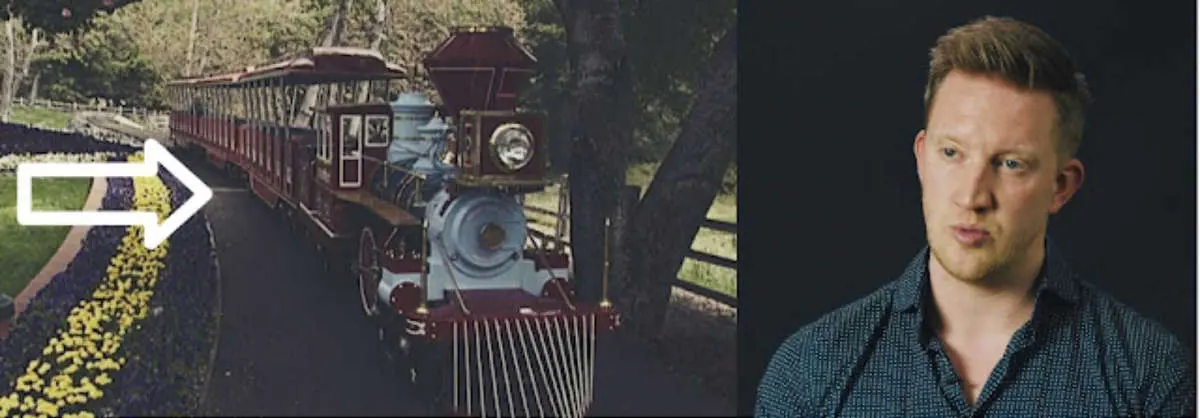
This train was not only fully operational during James Safechuck’s timeframe of abuse (between 1988 and 1992), but Jordan Hill and Mike Smallcombe also failed to acknowledge that it did not even match the photographs James presented in Leaving Neverland.
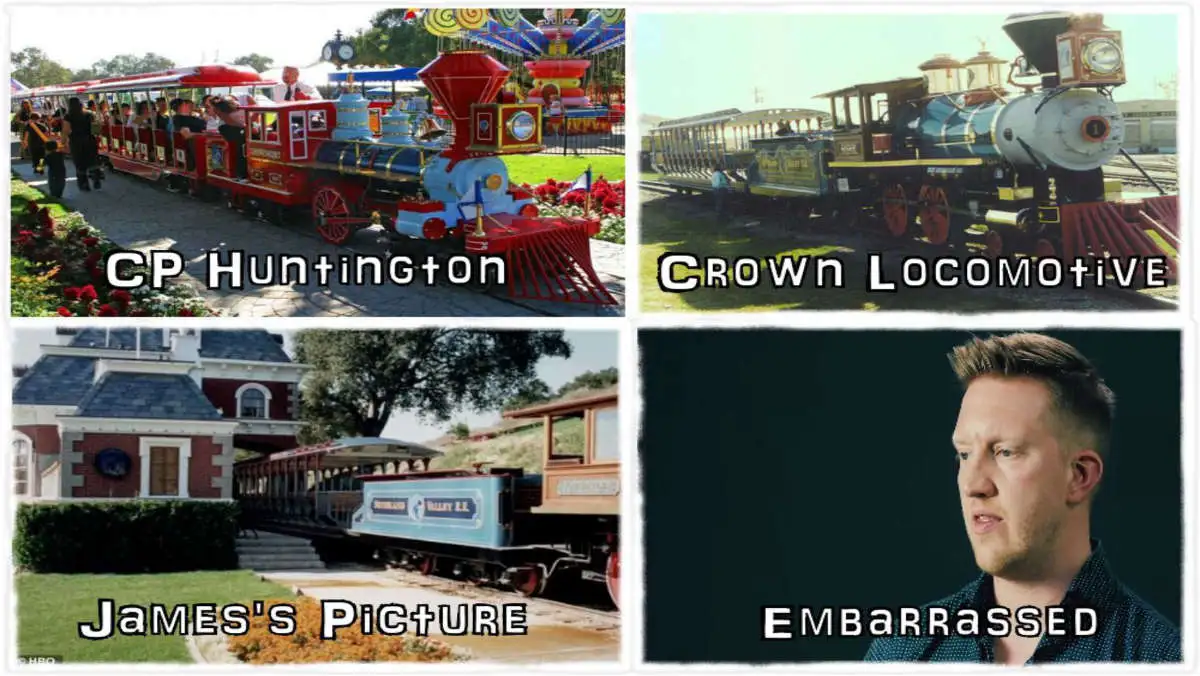
If I follow Mike Smallcombe’s reasoning to its natural conclusion, there is only one outcome. The presence of the smaller CP Huntington train, combined with the photographs of the main Neverland train station shown in Chase the Truth, strongly implies that the station existed before 1993. The CP Huntington was operating at Neverland from late 1990 onwards, and a functioning train requires at least one station. According to Smallcombe, there was only a single station on the entire ranch, as the screenshot below illustrates.

I reached out to Mike Smallcombe once again to ask whether he had previewed Chase the Truth before its August broadcast, and whether he still stands by every aspect of the documentary, including the on‑screen visuals and related material.
For this attempt, I used a different email address, fully aware that any message sent from my primary account would never receive a reply.
My first email on 10 October:
I recently watched a documentary you featured in, titled “Chase the Truth”. You specifically say, regarding the Neverland train station, that this has to be the train station where James Safechuck was allegedly abused, because it’s featured on-screen in Dan Reed’s Leaving Neverland.
I was wondering: did you have a chance to view the documentary before it was released in August, or are you happy with the way you appeared in it and stand by every word you said, along with the footage the director included during your on-screen appearance?
Looking forward to your response, and many thanks.
Mike Smallcombe’s response:
Hi, I don’t really understand what you mean.
My second email:
Hi,
Sorry for the confusion. What I’m asking is: do you stand by every word you said in that documentary, and are you happy with the way the director portrayed your on‑screen appearance?
Thanks.
Mike Smallcombe’s response:
I can’t recall saying anything I don’t stand by. Is there something that surprised you / I shouldn’t have said?
My third email:
Are you happy with all the images the director used while you were speaking? Did you have a chance to view the documentary before its release online?
Thanks.
At this stage, Mike Smallcombe vanished from the conversation entirely, refusing to engage with any further inquiries. Undeterred, I made one final attempt to contact him, hoping to establish whether he was aware of the significant error made by both himself and the director in featuring the wrong train — an oversight that effectively undermined their own argument.
Final message:
To be more precise, are you happy with the director showing images of the main Neverland train station, followed by a picture of the train—the very train while you’re speaking?
Thanks.
View the original emails here.
At its core, both Leaving Neverland and Chase the Truth present photographs and video clips in brief, passing moments, with little meaningful distinction between how either documentary uses them. Mike Smallcombe, however, adopts a sharply critical stance towards James Safechuck, insisting that James had every opportunity to correct any supposed misrepresentations by Dan Reed if the images shown were unrelated to the abuse. Yet, despite positioning himself as a Jackson authority—with one pro-Jackson book published and another on the way—Smallcombe failed to ensure that the director of Chase the Truth accurately represented the train in relation to the correct train station.
This oversight is particularly striking given the confidence with which he has made his claims over the past six months. A steady stream of tabloid articles, television appearances, and social media commentary has centred on his insistence that the visuals in Leaving Neverland undermine James Safechuck’s account. And yet, in a carefully produced, hour-long documentary that he had ample time to prepare for, Smallcombe ends up contradicting his own narrative.